

We are close enough to our September 1 deadline that we are beginning to receive the same question from several directions at once: What, specifically, are we looking for?
This is our attempt at an honest answer—honest enough to say some things that grant programs do not ordinarily put so bluntly in their official materials.
The Trojan horse, stated plainly

The Karski-Swyer Initiative to Promote Belarusian Studies is, at bottom, a Trojan horse—of the benign academic variety.
Two $2,000 awards will not, by themselves, reshape a field of study. What they can do is generate serious, citable work on contemporary Belarus; bring that work before universities and policy institutions; connect scholars and practitioners who should know one another; and help build the record needed to make the case for something permanent—ideally an endowed professorship in Belarusian studies.
We are trying to begin a multi-year conversation, not distribute two prizes and congratulate ourselves for having done so.
Applicants who understand this larger purpose will probably write stronger proposals. We want to know not only what question an applicant proposes to answer, but also why the answer matters, who should care about it, and where the completed work ought to be presented.
A project should be able to interest people who do not already spend their days thinking about Belarus.
The program, briefly
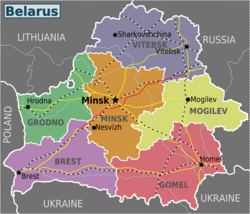
The Initiative is offering two parallel $2,000 awards for the 2026–2027 academic year.
Track I—Academic/Research Award. This award is open to an undergraduate or graduate student at Georgetown or another accredited institution, or to a postdoctoral researcher generally within five years of receiving a doctorate. The proposed project must address a contemporary issue involving Belarusian domestic & foreign policy (such as vis-à-vis the European Union countries, Ukraine, and the United States), government, and public opinion/sociology, with an emphasis on realistic alternative futures during the post-Lukashenka era on topics such as demographics.
Track II—Human Rights and Rule of Law Fellowship Award. This award is open to an individual—not necessarily a student—with a demonstrated record of work concerning Belarus in human rights, environmental protection, or the rule of law, including involvement in significant domestic or international legal proceedings. Candidates may apply directly or be nominated by someone else, with their consent.
Each recipient will receive $1,000 upon selection and an additional $1,000 after completing the work and presenting it, either in person or remotely, at an event hosted by an appropriate educational or nonprofit institution.
Belarusian citizenship is preferred but not required. Neither award requires a Georgetown affiliation.
Track I applicants should submit:
a 1,000–1,200-word research proposal;
two references, preferably professors or professional colleagues;
a current CV;
an academic transcript; and
a writing sample.
Track II applicants or nominators should submit:
a 1,000–1,200-word statement describing the candidate’s work and the relevant case, proceeding, or initiative;
two references, such as colleagues, co-counsel, or partner organizations;
a CV or professional biography;
supporting documentation, when available; and
a writing sample, if one exists.
Applicants should be prepared for a brief interview.
Applications and nominations are due September 1, 2026. Interviews will take place during September, and recipients will be announced on October 1, 2026.
Materials should be sent to ethansb@karski-swyer-belarus-initiative.org, with a copy to esb34@georgetown.edu.
Who will read the applications?
The reviewers are Peter H. Solomon, Donald N. Jensen, Victoria Leukavets, Curt Woolhiser, and Anton Saifullayeu—scholars and practitioners whose work concerns Belarus or closely related fields.
We assembled this group deliberately. A proposal about courts should reach someone who understands courts. The same should be true of a proposal involving diplomacy, human rights, national identity, or the relationship between Belarus and Russia.
Applications will be assigned according to the reviewers’ interests and expertise. Potential conflicts will be disclosed and addressed. The object is not bureaucratic uniformity; it is informed judgment.
Where might the completed work be presented?
Among the universities presently in play, we believe Georgetown is the strongest possible home for an eventual endowed professorship in Belarusian studies—and Washington, D.C., the strongest location.
That is a judgment, not a foregone conclusion. Columbia, Harvard, Johns Hopkins, and the University of Toronto each have a serious claim. Good work should be presented wherever it will encounter the most demanding and useful audience.
Georgetown University

Georgetown’s case begins with Jan Karski, who taught there for four decades, but it does not end with sentiment. The University continues to preserve and teach his legacy through the Jan Karski Collection and Georgetown University Press’s edition of Story of a Secret State.[1]

The Center for Eurasian, Russian and East European Studies already supports the kind of multidisciplinary regional scholarship that Belarus requires.[2]
Washington also puts scholarship within reach of the State Department, the Atlantic Council’s Eurasia Center, the Wilson Center’s Kennan Institute, Radio Free Europe/Radio Liberty, and the larger human-rights and rule-of-law community.[3]
Geography is not destiny, but in this instance it is a considerable advantage.
Columbia University

At Columbia, the Harriman Institute is the most obvious home for regional work. It has already hosted programs devoted specifically to Belarus, including presentations involving the democratic uprising and Belarus’s relationship with Russia.[4]
Depending on the subject, other appropriate Columbia venues might include:
Harriman’s East Central European Center, for work placing Belarus in its broader regional setting;
the Institute for the Study of Human Rights, for interdisciplinary work involving repression, civil society, political prisoners, or human-rights advocacy;
Columbia Law School’s Human Rights Institute, for projects involving international law, accountability, fair-trial rights, or the legal dimensions of authoritarian rule; and
the Institute for Israel and Jewish Studies, for work concerning Belarusian Jewish history, memory, antisemitism, the Holocaust, or the complicated relationship between Jewish and Belarusian identities.[4]
Columbia’s great advantage is not merely the number of its institutes. It is the possibility of putting different parts of the same Belarusian story into conversation with one another.
Harvard University

Harvard offers the Davis Center for Russian and Eurasian Studies and the Harvard Ukrainian Research Institute.[5]
HURI is particularly relevant to the Initiative’s longer-term ambitions. Its history demonstrates that diaspora-supported fundraising can lead not merely to an occasional lecture or fellowship, but to endowed chairs, an academic institute, publications, fellowships, and a durable field of study.
Belarusian studies does not yet possess an American institutional equivalent. One purpose of this Initiative is to begin asking why not.
Johns Hopkins University

At Johns Hopkins SAIS, the Foreign Policy Institute and the Henry A. Kissinger Center for Global Affairs could provide important audiences.[6]
The Kissinger Center’s emphasis on historically informed statecraft, diplomatic history, strategy, and international order makes it particularly appropriate for work on Belarus’s geopolitical position, its relationship with Russia and Europe, and the foreign-policy problems likely to confront a future democratic government.
One need not accept all of Henry Kissinger’s judgments to recognize the value of studying how history, geography, power, and statecraft interact. Belarus has suffered considerably from decisions made by larger powers that treated it as territory rather than as a country.
University of Toronto

The Munk School’s Centre for European, Russian and Eurasian Studies is another plausible venue, particularly for work combining regional expertise with public-policy analysis.[7]
Canada also has a substantial Eastern European diaspora and may provide a useful setting for work on diaspora organization, citizenship, immigration, and the relationship between exiled communities and future democratic governments.
European Humanities University
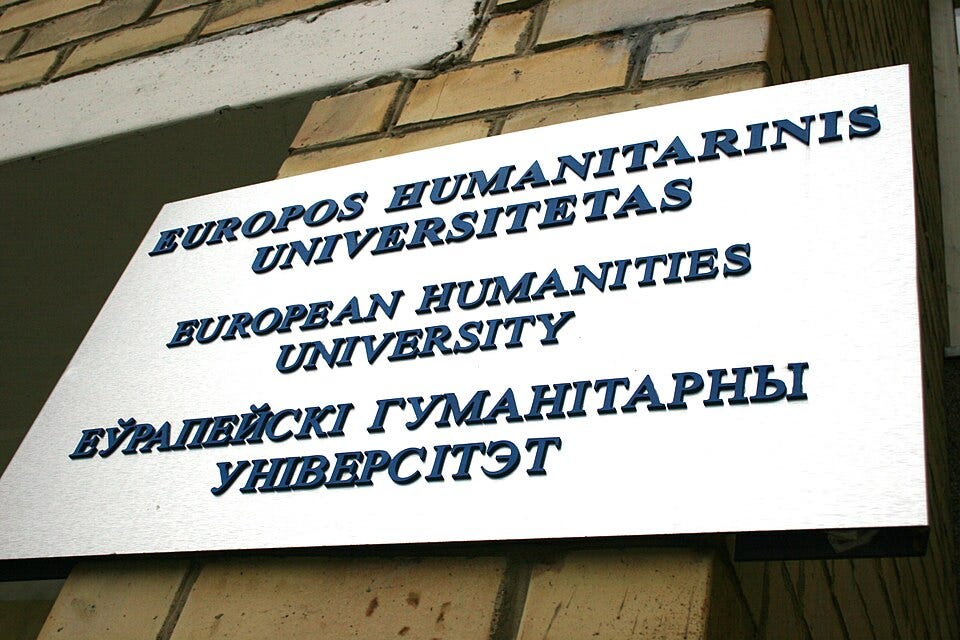
We strongly encourage applications from people currently affiliated with European Humanities University or holding EHU degrees.
EHU was founded to serve students from Belarus and the broader region. Its Center for Belarus and Regional Studies provides an independent, interdisciplinary platform for research into Belarusian history, politics, society, economics, culture, and media.[8]
Given what has happened to independent higher education inside Belarus, EHU is not simply another university that happens to teach Belarusian students. It is part of the intellectual infrastructure that a future Belarus will need.
Subjects to which we keep returning
We do not want to prescribe topics. Some of our best conversations have begun in directions we did not anticipate, and an initiative devoted to scholarship should remain capable of being surprised.
Still, the following subjects keep returning.
1. A democratic Belarus within the OSCE framework
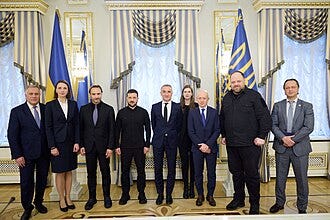
At some point, Belarus will have a government that answers to something other than Moscow and its own security apparatus.
What would a democratic transition require in practice—not as a slogan, but as an institutional program?
Possible subjects include judicial independence, electoral law, accountable government, minority protections, civilian control over the security services, and implementation of the human-rights commitments embodied in OSCE documents.[9]
Track I projects might design or compare institutions. Track II projects might document the present regime’s departures from accepted legal and human-rights standards.
Both forms of work are necessary: one records the damage; the other begins thinking about repair.
A related question is how a future Belarus should understand its own history. In a genuinely democratic and pluralistic Belarus, figures now claimed exclusively by Poland, Lithuania, Russia, Ukraine, or Israel might also be understood—without contradiction—as belonging to the history of Belarus.
Modern borders do not have to dictate historical memory.
2. Trade and investment integration with Europe
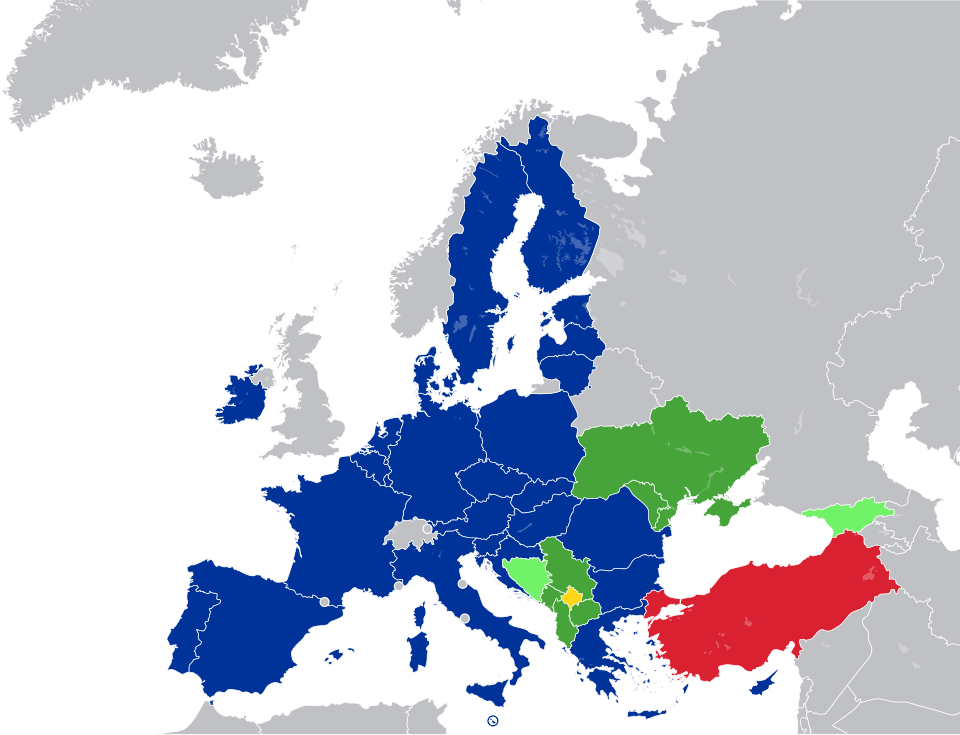
Political independence without economic options is a fragile thing.
What legal and economic framework would allow a future Belarus to deepen its trade and investment ties with the European Union without simply exchanging one form of dependency for another?
Moldova’s and Ukraine’s Deep and Comprehensive Free Trade Areas provide useful comparative models. The experiences of Estonia, Latvia, Lithuania, Poland, the Czech Republic, Slovakia, Bulgaria, and Romania may also illuminate the benefits and costs of regulatory convergence, market access, and economic transition.[10]
We would welcome work that treats customs rules, technical standards, investment protections, taxation, corporate governance, and sequencing as the substance of the inquiry—not as footnotes to a geopolitical argument.
3. Citizenship and the Belarusian diaspora
Belarus has lost people for generations—to war, persecution, economic stagnation, Russification, and the ordinary centrifugal force of history.
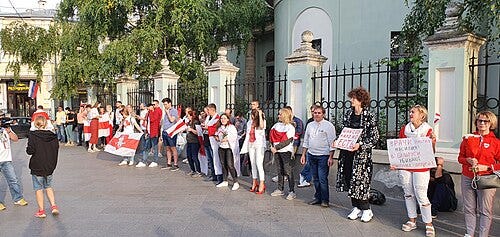
A future government should ask how many of their descendants might be invited back into a Belarusian civic community.
Ireland permits many people with an Irish-born grandparent to obtain citizenship through its Foreign Births Register.[11] A future Belarusian government could consider a comparable route—or accelerated residence and employment rights—for descendants of people born in the territory of present-day Belarus.
This subject is personal for me. My grandfather, Solomon Pinchas Swyer, was born in Vileika, later lived in Minsk, and emigrated to the United States in 1913. Many Americans, Canadians, Israelis, and others have similar family histories, although they may not presently think of those histories as Belarusian.
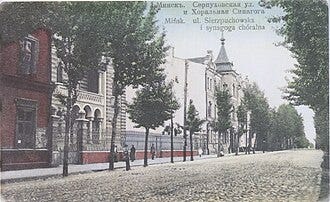
Today, unlike the descendants of people who fled Germany or Poland, relatively few descendants of Belarusian Jews are likely to be seeking Belarusian citizenship. That could change if Belarus became democratic, secure, tolerant, economically attractive, and honest about its past.
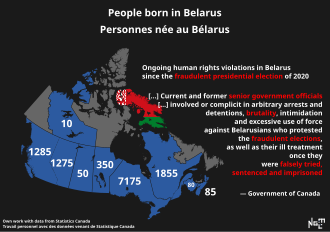
Citizenship, however, is the easy half of the problem. The harder question is institutional: how does a government build a durable relationship with a diaspora rather than summon it ceremonially once a year?
The Ukrainian Congress Committee of America, founded in 1940, unites national and local organizations, conducts advocacy, and participates in the Ukrainian World Congress.[12]
A useful comparative project could ask what a Belarusian-American or Belarusian-Canadian umbrella organization would need to look like—and what habits a future Belarusian government would need to learn—to make such a relationship real.
4. Belarusian identity in all its complexity
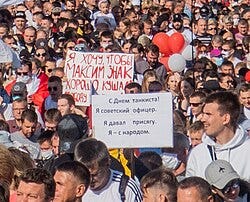
There is important work to be done in recovering the Belarusian connections of figures claimed—often exclusively—by several national traditions.
But this is not an invitation to write patriotic history with better footnotes.
Serious work must also confront antisemitism, the Holocaust and local collaboration, Soviet repression, and the effects of Polonization and Russification.
Belarusian, Lithuanian, Polish, Russian, Ukrainian, and Jewish histories overlap because the people themselves overlapped. Borders moved. Languages changed. Identities evolved. Empires classified people according to categories that did not always correspond to how those people understood themselves.
Strong scholarship should treat that complexity as the subject, not as an inconvenience to be edited out.[13]
What we do not want

We are not looking for advocacy dressed up as scholarship, conclusions in search of evidence, or a morality tale in which everyone already knows his assigned role.
Belarus has suffered enough from official narratives.
We want careful research, transparent methods, engagement with inconvenient evidence, and conclusions strong enough to withstand a skeptical room.
If a project cannot survive difficult questions, an award from us will not improve it.
The deadline, once more

Applications and nominations are due September 1, 2026. Interviews will take place during September, and recipients will be announced on October 1, 2026.
Additional information is available at karski-swyer-belarus-initiative.org.
If your proposed work does not fit neatly within one of the subjects described above, do not treat that as a warning. Surprise us—but show us why the work matters, who should hear it, and what it adds to the larger project of understanding Belarus and preparing for its democratic future.
Endnotes
[1] Georgetown University, “Medal of Freedom to Be Awarded Posthumously to Jan Karski,” https://www.georgetown.edu/news/medal-of-freedom-to-be-awarded-posthumously-to-jan-karski/; Georgetown University Library, “Jan Karski Collection,” https://findingaids.library.georgetown.edu/repositories/15/resources/10388; Georgetown University Press, Story of a Secret State, https://press.georgetown.edu/Book/Story-of-a-Secret-State.
[2] Georgetown University, Center for Eurasian, Russian and East European Studies, “About,” https://ceres.georgetown.edu/about/.
[3] Atlantic Council, “Eurasia Center,” https://www.atlanticcouncil.org/programs/eurasia-center/; Wilson Center, “Kennan Institute,” https://www.wilsoncenter.org/program/kennan-institute; Radio Free Europe/Radio Liberty, https://www.rferl.org.
[4] Columbia University, Harriman Institute, “About,” https://harriman.columbia.edu/about-us/; “What Does Belarus Teach Us? East European Revolutions from Warsaw and Prague to Kyiv and Minsk,” https://harriman.columbia.edu/event/what-does-belarus-teach-us-east-european-revolutions-from-warsaw-and-prague-to-kyiv-and-minsk/; Columbia University, Institute for the Study of Human Rights, “About Our Institute,” https://humanrights.columbia.edu/content/about-our-institute; Columbia Law School, Human Rights Institute, https://hri.law.columbia.edu/columbia-law-school-human-rights-institute; Columbia University, Institute for Israel and Jewish Studies, https://www.iijs.columbia.edu.
[5] Harvard University, Davis Center for Russian and Eurasian Studies, “About,” https://daviscenter.fas.harvard.edu/about; Harvard Ukrainian Research Institute, “History of the Institute,” https://www.huri.harvard.edu/history-institute.
[6] Johns Hopkins University School of Advanced International Studies, Foreign Policy Institute, “History,” https://www.fpi.sais.jhu.edu/history; Henry A. Kissinger Center for Global Affairs, https://kissinger.sais.jhu.edu.
[7] University of Toronto, Munk School of Global Affairs & Public Policy, “Centre for European and Eurasian Studies,” https://munkschool.utoronto.ca/cees.
[8] European Humanities University, “About,” https://en.ehuniversity.lt/about/; “Center for Belarus and Regional Studies,” https://en.ehuniversity.lt/research/center-for-belarus-and-regional-studies/.
[9] Organization for Security and Co-operation in Europe, “Helsinki Final Act,” https://www.osce.org/helsinki-final-act.
[10] European Commission, “Moldova,” https://enlargement.ec.europa.eu/countries/moldova_en; “The EU’s Association Agreements with Georgia, the Republic of Moldova and Ukraine,” https://enlargement.ec.europa.eu/news/eus-association-agreements-georgia-republic-moldova-and-ukraine-2014-06-23_en.
[11] Ireland, Department of Foreign Affairs, “Registering a Foreign Birth,” https://www.ireland.ie/en/dfa/citizenship/born-abroad/registering-a-foreign-birth/.
[12] Ukrainian Congress Committee of America, https://ucca.org.
; Ukrainian World Congress, “About the UWC,” https://www.ukrainianworldcongress.org/about-uwc.
[13] Serhii Plokhy, The Origins of the Slavic Nations: Premodern Identities in Russia, Ukraine, and Belarus (Cambridge University Press, 2006), https://www.cambridge.org/core/books/origins-of-the-slavic-nations/4276E1B428693C30E0DB6B46D8A90674; Timothy Snyder, The Reconstruction of Nations: Poland, Ukraine, Lithuania, Belarus, 1569–1999 (Yale University Press, 2003), https://yalebooks.yale.edu/book/9780300105865/the-reconstruction-of-nations.
The Karski-Swyer Initiative to Promote Belarusian Studies honors Jan Karski, the longtime Georgetown professor and wartime witness to the destruction of European Jewry, and Solomon Pinchas Swyer, who was born in Vileika and emigrated to the United States in 1913.