

The Karski-Swyer Initiative to Promote Belarusian Studies takes its name from two men who never met, separated by a generation and by very different fates, but connected by the same corner of Europe: the borderlands that today make up Belarus.
Jan Karski: The Witness Who Would Not Look Away
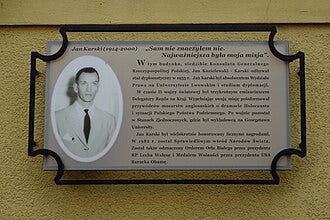
Jan Karski spent nearly forty years on Georgetown’s faculty, but he is remembered first for what he did before he ever set foot on the Hilltop. As a courier for the Polish Underground State during the Second World War, Karski was smuggled into the Warsaw Ghetto and into a transit camp so that he could carry an eyewitness account of the destruction of European Jewry to the leaders of the free world. He met with British officials, with U.S. Supreme Court Justice Felix Frankfurter, and with President Franklin D. Roosevelt himself. The warning was, by his own account, not fully heeded. That failure haunted him for the rest of his life — and it is precisely why he spent his subsequent career teaching, at Georgetown, the discipline of taking testimony seriously.
Karski went on to earn his doctorate at Georgetown in 1952 and to teach international affairs there until his retirement, becoming one of the University’s most decorated professors. He was named Righteous Among the Nations by Yad Vashem, received honorary Israeli citizenship, and was awarded the Presidential Medal of Freedom posthumously in 2012. His memoir, Story of a Secret State, remains a foundational document of Holocaust testimony and of the broader history of the region that produced him: the eastern borderlands of interwar Poland, now split among Poland, Lithuania, and Belarus.
Solomon Pinchas Swyer: An Ordinary Emigrant’s Extraordinary Journey
The Swyer half of this initiative’s name belongs to a much less documented life. Solomon Pinchas Swyer was born in Vileika, in what was then the Russian Empire’s northwestern territory and is today Belarus, before later living in Minsk. Like so many Jewish families from that region, the Swyers left — Solomon emigrated to the United States in 1913, part of the great wave of departures that emptied the shtetls and provincial towns of the Pale of Settlement in the years before the First World War rendered emigration nearly impossible.
Solomon Pinchas Swyer never testified before a president or received a state medal. His story is preserved the way most family stories are: through documents pieced together generations later, through a name on a ship’s manifest, through the stubborn work of a grandson determined not to let a birthplace disappear from memory. That grandson is one of the people behind this initiative.
Pairing Karski’s name with Swyer’s is a deliberate statement about whose history counts. Belarusian studies as a field has often been squeezed between Polish, Russian, and Ukrainian scholarship, treated as a footnote to its larger neighbors. The people who actually came from that ground — the resistance couriers who became world-historical witnesses, and the ordinary emigrants whose names survive only in family papers — deserve a field of their own.
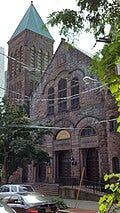
Then, living on South Pearl Street in Albany, New York, through contemporary newspaper accounts, Solomon Swyer learned of Jan Karski’s largely unheeded mission to alert the world—and, in particular, President Franklin D. Roosevelt—to the ongoing destruction of European Jewry. He deeply regretted the failure of those in positions of influence to make the world fully aware of the Shoah and to pursue policies that might have saved more lives.
Why Belarusian Studies, and Why Now
Belarus rarely makes headlines except during crisis — the falsified 2020 election, the crackdown on civil society, the war next door in Ukraine. Serious, sustained academic attention to Belarusian history, law, language, and civil society remains thin at American universities, even as a determined Belarusian democratic movement continues to organize in exile and Belarusian scholars themselves face closures and blacklisting at home, including the extremist designation slapped on the European Humanities University’s Belarusian programs by Belarus’s own Supreme Court earlier this year.
The Karski-Swyer Belarus Initiative aims to help fill that gap at Georgetown, building on the University’s existing strengths — the Center for Eurasian, Russian and East European Studies, the Center for Jewish Civilization, and Georgetown Law’s long engagement with post-Soviet legal reform. The initial phase centers on modest, achievable steps: named awards recognizing contemporary scholarly and civic engagement with Belarus, a growing archive of source materials, and outreach to other educational institutions. The long-term goal is more ambitious: an endowed chair in Belarusian Studies that ensures this field has a permanent home rather than depending on the enthusiasm of any one generation. As an alternative location for the endowed chair, the Initiative would support it being located at another suitable educational institution such as Columbia, Harvard, or Johns Hopkins University in the U.S. and the University of Toronto in Canada.
What Comes Next
The Initiative is using this Substack to share information connected to its research grant and fellowship support program and on the broader case for institutionalizing Belarusian Studies in American and Canadian higher education. If you are a scholar, alumnus, or institution with an interest in this work — or simply someone who believes that the history of a country should not be told only by its neighbors — we would welcome hearing from you.
The Karski–Swyer Initiative to Promote Belarusian Studies is an emerging project dedicated to establishing an endowed chair in the United States for a distinguished scholar and advocate whose work advances good governance, human rights, international law, and tolerance in a post-Lukashenko Belarus.