

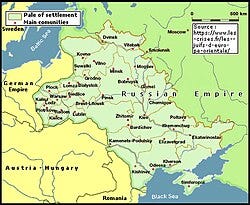
Author's Note: This piece grew out of a request for more on the conditions Jews faced in the territory that later became Belarus, before my grandfather emigrated. I'm a Sovietologist and lawyer, not a historian, and I don’t read Belarusian, German, Hebrew, Polish, or Yiddish, so this rests on English and Russian-language sources. For the real thing, see Timothy Snyder (Toronto), especially Bloodlands (2010) and Black Earth (2015), and timothysnyder.org. Also see Nancy Sinkoff (Rutgers), a childhood friend and college classmate, at the Rutgers Center for the Study of Jewish Life; her new book, Polish Jewish Culture Beyond the Capital (2023), won PIASA's 2024 Cienciala Award. Concert: https://polishjewishmusic.iu.edu/
A Jew in the Street: New Perspectives on European Jewish History (2024).
Nearly a thousand years ago, Polish monarchs invited Jews into their lands, hoping their commercial and financial skills would help build up the country’s economy. Many of the arrivals were themselves refugees, fleeing persecution elsewhere in Europe. The relationship that followed was reciprocal. Jews became integral to the Polish economy, and by the years before partition they made up roughly one in ten of the population of the Polish lands as a whole, and a far higher share in the cities. Kraków, Vilna, and Warsaw grew into major centers of Jewish culture and scholarship on the strength of that urban concentration.
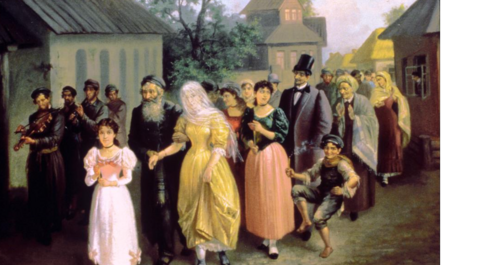
Jewish Wedding. A. Trankowsky (Алексей Транковский), late 19th century. Oil on canvas. (The Judah L. Magnes Museum, Berkeley, California)
None of this made Poland uncomplicated. The common history was not free of hard times, and periods of acceptance by Catholic neighbors coexisted with episodes of tension rooted in economic competition and other frictions. But the relationship was durable enough that when Poland re-emerged as an independent state after the First World War and had to fight for its survival against Soviet Russia, Jews took up arms alongside Catholic Poles to repel the Bolsheviks. The interwar Polish republic that resulted was a genuinely heterogeneous country, home to large German, Ukrainian, Belarusian, and Jewish communities — and the Jewish community was itself far from monolithic in its own sense of identity.
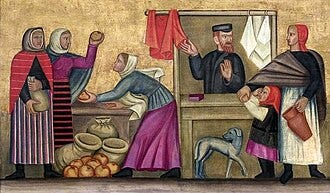
Helena Schrammówna, Market scene, 1924.
This is the Poland that later generations, including many Polish Catholics only now discovering Jewish roots hidden in their own family histories, still struggle to sum up in a few words. It is also, crucially, not the same Poland that the Jews of the Belarusian lands experienced after 1795. Grodno, Minsk, Vitebsk, and Mogilev did not fall to a re-emergent Polish state, or to Habsburg Galicia. They fell almost in their entirety to the Russian Empire, whose treatment of its new Jewish subjects diverged sharply from the pattern of qualified acceptance described above.
THE IMPERIAL VARIABLE
Look at the three partitioning powers side by side — Russia, Austria, and Prussia — and a pattern emerges: the “push” factors that drove mass Jewish emigration out of the former Polish-Lithuanian lands were disproportionately the product of Russian imperial policy, not of partition itself. That matters enormously for the Belarusian lands in particular, since virtually the entire Jewish population of the Grodno, Minsk, Vitebsk, and Mogilev gubernias fell under Russian rather than Habsburg or Hohenzollern administration.
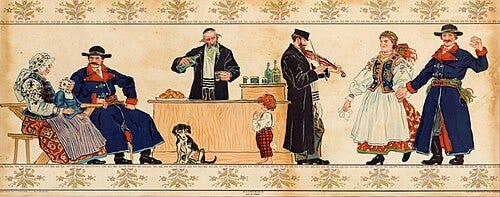
Gustaw Pillati, Wilanów Frieze, Peasants of the village of Wilanów (now part of Warsaw) merrymaking in a Jewish-run tavern
The Pale of Settlement, created by, created by Catherine II’s decree of 1791 and expanded after later partitions, walled in roughly five million Jews by the turn of the twentieth century — a population that could not leave the zone without special dispensation: conversion, first-guild merchant status, or a university diploma. [1] Inside the Pale, Jews were largely barred from landownership and agriculture and legally corralled into an artificially narrow band of occupations, which produced chronic underemployment no individual family or enterprise could fix on its own. [2] This was not the byproduct of some general agrarian crisis touching all of the Tsar’s subjects equally. It was policy-engineered scarcity.
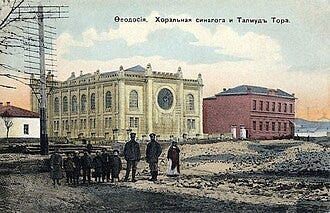
Хоральна синагога у Феодосії, побудована в 1904 р., була відібрана радянською владою в 1929 р., зараз - Будинок офіцерів. Праворуч від неї-Талмуд-Тора (тепер школа № 19).
Then came conscription, and here the record is especially hard to read. Nicholas I’s Recruitment Statute of August 1827 imposed a twenty-five-year military term on Jewish males aged twelve to twenty-five — with the clock not starting until the conscript turned eighteen, so that a boy taken at twelve could face thirty-one years under state control before release. [3] Jews were the only population conscripted as young as twelve; every other subject of the Tsar was drafted between eighteen and thirty-five. [4] Quotas were handed down to the kahal, the local Jewish communal leadership, who bore the responsibility of filling them — and when they couldn’t, khappers, professional child-snatchers, seized boys off the street, often orphans or the sons of the poor.
Few Russian policies did more damage to the internal fabric of Jewish communal life. [5] Historians’ estimates of how many Jewish boys and men were swept into the cantonist system over three decades range from roughly 30,000 to as many as 70,000 or 75,000, and there is real disagreement over how many were pressured or coerced into converting to Russian Orthodoxy — figures run from about a quarter to nearly half of the cantonist minors. [6] Even after later regulations formally put Jewish and Christian cantonists on the same footing, discriminatory sub-regulations kept unconverted Jews from being promoted. Conversion pressure remained the system’s unstated purpose throughout. [7]
Violence followed, and here too the state’s role is worth being precise about. The wave of pogroms that broke out after the assassination of Alexander II in March 1881, and the “Temporary Regulations” — the May Laws of 1882 — that followed, mark the point most historians now treat as the true beginning of mass Jewish emigration from the Russian Empire. [8] It would be an overstatement to say St. Petersburg organized every riot; historians today are more careful about that claim than they once were.
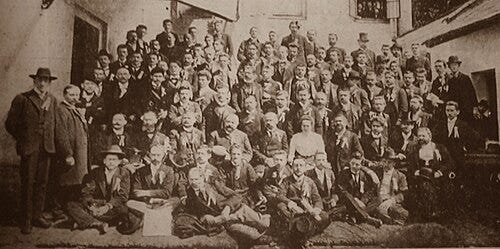
Jewish Community Bielsko Biala Poland, Zionist Congress Bielitz, May 19, 1902.
But the imperial administration, having found in Jews a convenient scapegoat for broader unrest, routinely failed to meaningfully suppress the violence once it started, and in documented cases allowed local police and Cossack units to stand down or arrive late. [9] Further waves in 1903–1906 and 1919–1920 compounded the damage, and the government’s insistence on preserving the Pale and its disabilities even after 1881 makes clear that the underlying legal architecture of exclusion — not just mob violence — was official policy. [10] The numbers bear this out starkly: Jews made up at least seventy percent of all emigration from the Russian Empire in every year between 1882 and 1898, and roughly a third of all emigrants from the Empire between 1871 and 1910 — a share wildly out of proportion to their share of the general population. [11]
Compare that to Galicia. The Jewish populations that fell under Habsburg rather than Russian rule after the partitions — chiefly in Galicia, which after 1772 took in a large swath of formerly Polish-Lithuanian territory — followed a genuinely different path. Austria’s constitutional reforms of 1848 began dismantling estate-based Jewish taxes, and the constitutional settlement of 1867 formally emancipated Jews as full citizens, lifting restrictions on landownership, guild membership, government employment, and university teaching. [12]
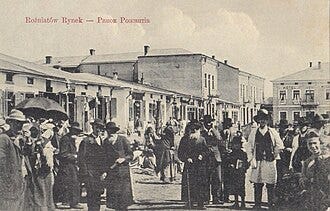
Marlet Squuare in Rożniatów, 1910
Galician Jews were not conscripted younger or on harsher terms than anyone else, were not confined to anything resembling the Pale, and were not the targets of state-tolerated pogrom violence on the Russian pattern. [13] None of which is to romanticize Habsburg Galicia — antisemitic agitation, economic boycotts, and localized anti-Jewish riots did occur there too, notably in western Galicia in 1898, and legal emancipation coexisted with plenty of everyday social antisemitism. [14] But the difference in the posture of the state itself is well documented. By the early twentieth century, Galician Jews had a foothold in commerce, skilled trades, and industry, and — notably — in the liberal professions, civil service, and self-employed expert occupations, at rates essentially closed off to their coreligionists across the Russian frontier. [15]
Prussia moved fastest of all. Jews in the Prussian-annexed portions of partitioned Poland — above all the Posen/Poznań region — were emancipated even earlier and more thoroughly than in Austria. Prussia’s 1812 Emancipation Edict gave Prussian Jews civil rights and, crucially, occupational access — including to the professions and to state institutions of higher learning — that Russian Jews would not approach even in principle until the monarchy fell in 1917. [16] The German Empire’s 1871 constitution completed legal equality nationwide. That helps explain something that might otherwise look like a coincidence: why the demographic weight of Polish-Lithuanian Jewry, and later the great emigration wave, sat so heavily in the former Russian partition rather than the former Prussian one. The Jewish population under Prussian rule started smaller, but it also had far less reason to flee westward, having already reached rough legal parity inside a wealthier, more diversified economy.
Because Grodno, Minsk, Vitebsk, and Mogilev sat entirely inside the Russian Pale, the communities at the center of this story felt the full weight of cantonist conscription, May Laws restriction, and pogrom-era insecurity, with no Habsburg or Hohenzollern alternative available to them the way it was to Jews in Kraków or Lwów. The exodus from these Belarusian-lands communities to the United States, South Africa, and elsewhere between the 1880s and 1914 shouldn’t be filed away as one more generic “Old World hardship” story, interchangeable with every other East European Jewish emigration. It was a response calibrated to specific, documentable Russian state policy — conscription law, residential and occupational restriction, toleration of communal violence — measured against a visible, known alternative just across the Austrian and German frontiers. Many Russian-Jewish emigrants knew about that alternative through family and trade networks long before they ever boarded a ship. [17]
WAR AND REVOLUTION, 1914–1921
If the period from 1881 to 1914 established emigration as a principal Jewish response to persecution and insecurity in the Russian Empire, the years 1914 to 1921 brought a compressed sequence of catastrophes: military expulsion, revolution, civil war, pogroms, and the Polish–Soviet War. Across much of the former Pale of Settlement, these events destroyed communities, displaced populations, and transformed the legal and political setting of Jewish life. Flight remained one response, but for many communities it was no longer practicable; they instead endured the violence directly.
From the opening months of the First World War, the Russian military command increasingly treated Jews in the western borderlands as presumptive security threats. In early 1915, military policy authorized expulsions from front-adjacent areas and the taking of hostages in an effort to deter alleged espionage and assistance to the enemy. These measures affected both Russian-subject Jews and Jews living in occupied Austrian Galicia. [18]
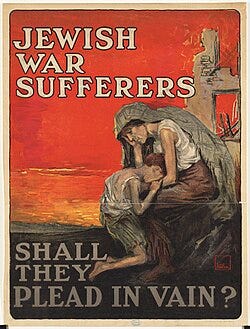
Jewish war sufferers. Shall they plead in vain?, American Jewish Joint Distribution Committee (sponsor)Grinnell Litho Co., New York, 1917 (approximate)
The largest single expulsion occurred in May 1915, when General Nikolai Radkevich, with the support of Chief of Staff Nikolai Yanushkevich, expelled approximately 200,000 Jews from the Kovno and Kurland provinces — an operation that disrupted transportation and disorganized the army’s own rear areas. [18][19] Between 1914 and 1916, at least 189 Jewish communities in the Russian Empire, Galicia, and Bukovina experienced expulsion or deportation. [18] Contemporary accounts describe deportees being sent deep into the Russian interior under conditions of severe deprivation, and often encountering hostility from people who regarded them as suspected traitors rather than as displaced fellow subjects. [20][21]
By August 1915, the government permitted many Jewish refugees to settle outside the Pale, although restrictions remained in Petrograd and Moscow. The Pale therefore ceased to function effectively as an impermeable residential boundary well before its formal abolition. [22] On March 20/April 2, 1917 (Old Style/New Style), the Provisional Government abolished legal disabilities based on religion or nationality, including restrictions affecting Jewish residence, education, public service, and occupation — bringing formal civic emancipation to Russian Jewry roughly fifty years after Jewish emancipation in Austria-Hungary, and more than a century after Prussia’s 1812 emancipation edict.
The fall of the autocracy in February/March 1917 was, in legal terms, an extraordinary liberation for Russian Jews. The Provisional Government’s decree dismantled the principal legal apparatus of residential and occupational discrimination. The political and military collapse that followed, however, soon created different and more immediate dangers.
The Bolshevik seizure of power and the ensuing civil war intensified the antisemitic myth of “Judeo-Bolshevism,” which portrayed Jews collectively as agents or beneficiaries of revolution. That claim ignored the political diversity of Jewish communities, the relatively small proportion of Jews who were Bolsheviks, and the fact that Jewish socialist and Zionist organizations — including the Bund and Po’alei Zion — were themselves eventually suppressed by the Bolshevik regime. Nevertheless, the myth supplied a recurring justification for anti-Jewish violence by otherwise antagonistic military and political factions. [23]
The pogrom wave accompanying the Civil War — concentrated primarily in Ukraine but extending into Belarus and other parts of the former Pale — was far larger and deadlier than the pogrom waves of the late imperial period. Estimates vary, because contemporary documentation was incomplete and because historians distinguish differently among immediate deaths, later deaths from wounds or disease, and broader wartime mortality. Nokhem Gergel’s foundational study documented more than 1,200 incidents and estimated roughly 50,000 deaths; more recent scholarship, including Jeffrey Veidlinger’s, places the death toll above 100,000. [24] The toll is best described as disputed, and probably somewhere between the tens of thousands and more than 100,000.
Gergel identified 1,236 episodes of anti-Jewish violence, of which 887 were classified as mass pogroms. His attribution data assigned roughly 40 percent of the documented pogroms to forces associated with the Ukrainian People’s Republic, 25 percent to independent or “Green” formations, 17 percent to White forces, and 8.5 percent to Red Army units — figures that measure documented incidents, not necessarily a precise division of total deaths. [26]
Responsibility was thus distributed across several forces, although not equally. A recurrent enabling condition was impunity: soldiers and irregulars often understood that robbery, assault, rape, and murder directed against Jews would bring little or no punishment. Pogroms combined antisemitic ideology, allegations of Bolshevik sympathy, plunder, military indiscipline, and the brutalization produced by prolonged warfare. The violence also generated mass displacement and extensive destruction of Jewish homes and communal property.
For an essay centered on Belarus, the Polish–Soviet War is especially important. The front crossed Grodno, Minsk, Pinsk, and Polesia as Polish and Bolshevik forces repeatedly gained and lost territory.
The best-known episode was the Pinsk massacre of April 5, 1919. Major Aleksander Narbutt-Łuczyński ordered the summary execution of thirty-five Jewish residents whom he suspected, without an adequate investigation, of participating in a Bolshevik meeting. The subsequent American mission led by Henry Morgenthau concluded that no Bolshevik arguments had been made at the meeting, characterized the commander’s reliance on untested allegations as “reprehensible and frivolous,” and called his action “inexcusably drastic.” It also rejected as unfounded the claim that Jewish participants had attacked Polish troops. [27][28]
Pinsk was not the only instance of anti-Jewish violence involving Polish troops. Recent scholarship documents violence in Bobruisk in 1919 and situates it within a broader pattern in which soldiers associated Jewish civilians with Bolshevism and treated them as politically suspect. [29]
Jewish communities in the Belarusian lands were also victimized by irregular formations. One account of David-Gorodok reports that forces associated with Stanisław Bułak-Bałachowicz imposed a large ransom on the town and committed robbery, rape, and murder. [30]
The Treaty of Riga, signed on March 18, 1921, ended the Polish–Soviet War and established a border that divided the Belarusian lands between Poland and the Soviet republics. Jewish communities on either side of that border thereafter developed under sharply different political and legal systems — a division that profoundly shaped their interwar histories. [31]
The experience of pogroms helps explain why some Jews came to regard Soviet rule as comparatively protective, or chose to cooperate with it. The Bolsheviks formally prohibited antisemitic agitation, and although Red Army units also committed pogroms, Soviet authorities were generally more willing than their rivals to condemn and punish such violence. It is reasonable to infer that physical insecurity made Soviet power comparatively attractive to some Jewish civilians — though that conclusion should not be generalized to all Belarusian Jews, or described simply as ideological conversion. [32]
Nor did Soviet rule preserve autonomous Jewish communal life. The Jewish Sections of the Communist Party — the Yevsektsiya, established in 1918 — campaigned against Zionist organizations, independent Jewish political parties, Hebrew education, synagogues, and traditional religious schooling. The physical security associated with the new order was therefore accompanied by a systematic assault on independent Jewish religious, political, and communal institutions. [33]
Put these two chapters together — imperial confinement, then war and revolution — and they explain something that might otherwise seem strange: why Warsaw could still stage a living Shabbat service in 2007 and ask, however uneasily, whether its Jewish community might yet be more than a novelty, while the Jews of the Belarusian lands, subject to a harsher and more consistently applied imperial design and then to war, revolution, and civil war on top of it, mostly answered the same question a lifetime earlier — by leaving, or did not live to answer it at all. Both stories trace back to the same eighteenth-century Commonwealth. What diverged was which empire, and later which army, drew the border around each community’s fate.
Endnotes & Citations
1. Britannica — Pale of Settlement; see also Wikipedia — Jewish Ethnographic Expedition
2. The Nation — The Saga of the Pale and Soviet Jews
3. JewishEncyclopedia.com — Cantonists
4. Military History Wiki — Cantonist (citing Benjamin Nathans)
5. The Jewish Link — 1827: Russia Begins to Draft Its Jews; see also Shavei Israel — Russian Cantonists
6. Academic Studies Press — Tsar Nicholas I and the Jews; compare with figures in Times of Israel — The Cantonists
7. Military History Wiki — Cantonist Sub-regulations
8. Harvard HIST 1290 — Jewish Persecution, Emigration and the Russian State
9. EBSCO Research Starters — Pogroms in Imperial Russia
10. TheCollector — The Dark History of the Pogroms That Shook the Russian Empire; see also Wikipedia — Pogroms in the Russian Empire
11. Harvard HIST 1290 — Emigration Figures (citing Yannay Spitzer, PhD diss., Northwestern University, 2013)
12. Ukrainian Jewish Encounter — The Jewish Question in Austrian Galicia
13. JGaliciaBukovina — The Jews of Galicia under Austrian-Polish Rule, 1867–1918 (Piotr Wróbel)
14. YIVO EPYC — Political Life in Galicia
15. Zolynia Memorial — Galicia Province Occupational Breakdown
16. For general historiography on Prussian emancipation, see Reinhard Rürup, “Jewish Emancipation and Bourgeois Society,” Leo Baeck Institute Year Book 14 (1969).
17. Synthesis on comparative migration networks supported by Spitzer (2013), supra note 11.
18. 1914-1918 Online — Antisemitism and Pogroms in the Military (Russian Empire) (Semion Goldin)
19. Palgrave Macmillan — Deportations of the Jewish Population and Hostage Taking (1914–1915) (Eric Lohr)
20. Jerusalem Post — Accounts of Russian Tactics in WWI
21. 1914-1918 Online — Resettlement (Peter Gatrell)
22. Jewish Virtual Library — The Pale of Settlement
23. Brendan McGeever, Antisemitism and the Russian Revolution (Cambridge University Press, 2019); see also Ukrainian Jewish Encounter — Between the ‘Whites’ and the ‘Reds’
24. Nokhem Gergel, “The Pogroms in the Ukraine in 1918–21,” YIVO Annual of Jewish Social Science 6 (1951); Jeffrey Veidlinger, In the Midst of Civilized Europe: The Pogroms of 1918–1921 and the Onset of the Holocaust (Metropolitan Books, 2021).
25. University of Toronto Munk School — In the Midst of Civilized Europe
26. Gergel (1951), supra note 24.
28. William W. Hagen, “Soldierly Antisemitism, the Pinsk Massacre, and Morgenthau’s Mission,” in Anti-Jewish Violence in Poland, 1914–1920 (Cambridge University Press, 2018), DOI:10.1017/9781139025737.012
29. Marcin Urynowicz, “Anti-Jewish Violence of Polish Troops, 1918–1920: The Case of Bobruisk,” East European Jewish Affairs (2023), DOI:10.1080/13501674.2022.2162214
30. Encyclopedia.com — David-Gorodok (reproduced from Encyclopaedia Judaica)
31. 1914-1918 Online — Riga, Treaty of (Jerzy Borzęcki)
32. McGeever (2019), supra note 23.
33. YIVO Encyclopedia of Jews in Eastern Europe — Evsektsiia (Zvi Gitelman)