

Population decline, political exile, and whether the diaspora can become part of Belarus’s recovery
Belarus is not simply losing population. It is losing many of the people best positioned to renew its economy and institutions. The country’s future will depend in part on whether that loss becomes permanent - or whether a future government can rebuild ties with the Belarusians now living abroad.
Demography is more than a statistic
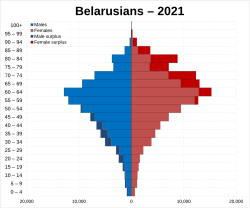
Belarusians_ethnic_group_population_pyramid_2021, January 11, 2023
Nations are territories and governments, but they are also populations with trajectories. When births remain below replacement, the workforce shrinks, the population ages, and large numbers of educated citizens leave; demography constrains almost everything else: economic growth, pension systems, military manpower, and the survival of a national language and culture.
Few scholars demonstrated this more clearly than Murray Feshbach, the U.S. Census Bureau analyst and later Georgetown and Wilson Center scholar. By reading Soviet statistics skeptically and cross-checking national claims against local data, Feshbach exposed health and population crises that the Soviet state preferred to conceal.[1] His method remains useful for Belarus: official figures matter, but they must be tested against receiving-country data and independent research.
That approach reveals a country facing not one demographic problem but several at once. Belarus has inherited the losses of war and Chernobyl, endured three decades of low fertility and aging, and since 2020 experienced a politically driven exodus concentrated among younger, educated, and mobile citizens. These forces reinforce one another.
A long history of population loss
Belarus entered independence carrying extraordinary demographic scars. Roughly one-quarter of its population died during the Second World War. Four decades later, the Chornobyl disaster contaminated about 23 percent of Belarusian territory, affected more than 2.5 million people, and led to large-scale resettlement.[2] The health consequences remain contested, but the disaster’s effects on settlement patterns, public confidence, and fertility decisions are undeniable.
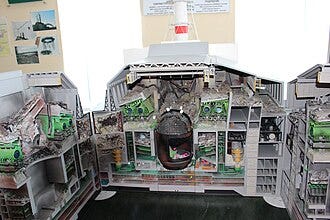
Chernobyl_Reactor_4_model_inside, October 18, 2019
The country’s population peaked at about 10.24 million in 1993-94 and has declined in nearly every year since.[3] Before 2020, the fall was gradual: low birth rates, high working-age male mortality, aging, and steady emigration to Russia and, increasingly, the European Union. The political crisis of 2020 transformed that slow decline into something more dangerous.
The post-2020 exodus
The disputed August 2020 presidential election, the mass protests that followed, and the regime’s repression created a demographic turning point. Belstat reported 9,155,978 residents at the start of 2024; subsequent figures indicate continued rapid decline. Only 58,900 children were born in 2024, the lowest annual total since 1950, while independent analysts place the fertility rate near one child per woman - less than half the replacement rate.[4] The number of women in the principal childbearing ages has also fallen sharply. Even a successful family policy would therefore operate from a smaller base.
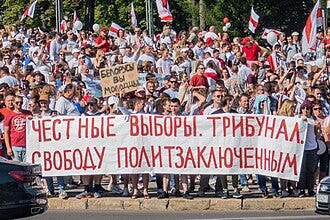
2020 Belarusian protests in Minsk, August 16, 2020.
Emigration makes the problem qualitatively worse. Estimates vary because many political exiles do not formally deregister in Belarus, but independent studies place post-2020 departures in the hundreds of thousands. One recent assessment estimates that 400,000 to 418,000 Belarusians now live and work abroad because of the post-2020 wave - roughly 4.5 percent of the resident population and more than 6 percent of the working-age population.[5]
Those who left were not a random cross-section of society. They were disproportionately young, educated, entrepreneurial, and politically engaged. The information-technology sector, once the showpiece of the Belarusian economy, lost an estimated 20,000 to 25,000 professionals in the first years after 2020. Its export revenue fell from about $3.2 billion in 2021 to roughly $1.8 billion in 2023, while its share of GDP was approximately halved.[6] This is the economic price of political repression expressed through population movement.
The breakdown was visible almost immediately. In 2020, authorities raided PandaDoc’s Minsk offices after its Belarusian founder criticized the crackdown and supported police officers who resigned in protest. The government also imposed internet shutdowns on an industry that depended on global connectivity.[7] A sector the state had cultivated became a source of presumed disloyalty, and many of its workers concluded that professional security required departure.
What Russia’s wartime exodus shows
Russia’s invasion of Ukraine in February 2022 and its partial mobilization that September produced a larger version of the same phenomenon. Estimates suggest that between 500,000 and more than 900,000 Russians left, with at least 650,000 still abroad by mid-2024.[8] The emigrants were heavily concentrated among university graduates, technology workers, and draft-age men. Russia’s Ministry of Digital Development estimated that about 100,000 IT professionals left in 2022 and did not return.[9]
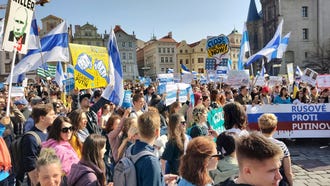
Protest by Russians living in the Czech Republic against the war in Ukraine. Prague, Old Town Square, March 26, 2022.
The comparison should not obscure the differences. Russia’s exodus was much larger in absolute numbers, but Belarus’s loss was more severe in proportion to its population and workforce. Moscow also offered tax and conscription concessions to technology workers and benefited from continuing energy revenue. Minsk has fewer resources and has made return more dangerous through extremist designations, criminal cases, and pressure on exiles and their families.
The shared lesson is nevertheless clear: authoritarian governments tend to export precisely the citizens they most need for modernization. Repression and war turn political disagreement into human-capital flight. Official statistics then understate the damage because many departures are temporary in law even when they become permanent in life.
A deeply rooted diaspora
Belarusian dispersal is not new. Economic migrants left Western Belarus between the world wars; political refugees fled renewed Soviet rule after 1945; and much of the country’s historic Jewish population emigrated late in the Soviet period and after independence.[10] The post-2020 wave, however, is unusually concentrated in nearby countries and closely connected to Belarus through family, language, work, and digital networks.
Poland and Lithuania host the largest communities. Tens of thousands of Belarusians also live in Georgia, Germany, the United Kingdom, the United States, Canada, and the Netherlands.[11] Belarusian businesses have re-registered abroad, while exiled professionals are gaining experience in European legal, financial, academic, and technological institutions. This is a painful loss to today’s Belarus, but it could become development capital for a future one.
Other countries have treated the relationship between homeland and diaspora as a long-term policy question. Israel is one prominent example, but Central and Eastern European states after 1989 offer closer comparisons: they used returning citizens, diaspora investment, and foreign-trained experts to rebuild institutions. Belarus cannot copy any one model. It can, however, begin treating its diaspora as part of the nation’s future rather than as a population permanently written off.
What the official data miss
Belstat generally counts an emigrant only after formal deregistration. Political exiles often avoid that step because they hope to return or fear consequences involving property, taxes, or military service. This creates a striking mismatch between Belarus’s reported net migration and the number of Belarusian citizens appearing in residence, employment, and visa records elsewhere.[12]
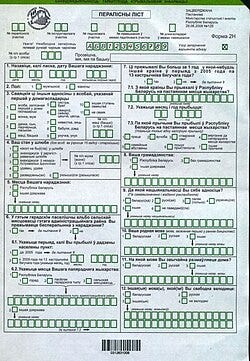
Форма 2Н переписного листа переписи населения 2009 года в Белоруссии на белорусском языке, Министерство статистики и анализа Респу
The proper response is not to dismiss official statistics but to triangulate them. Births, deaths, school enrollment, regional population figures, border movements, foreign residence permits, and labor-market data each reveal part of the picture. That is the Feshbach method adapted to the present: look for what the state’s aggregate figures omit, then reconstruct the trend from other evidence.
Why the pressure may intensify
The exodus may not have reached its ceiling. Belarus has become more deeply entangled in Russia’s war against Ukraine. Changes to military doctrine and conscription enforcement, including stronger penalties and authority to restrict travel by draft-age men, increase the perceived risk of future mobilization.[13] Analysts disagree about whether Alyaksandr Lukashenka wants direct participation in the war, but demographic behavior responds to perceived danger, not only to announced policy.
DIMK_Ministr_oboroni_vstrecha_s_lykashenko-550, February 3, 2022.
Russia’s experience showed how quickly anticipatory fear can produce mass departure.
Economic isolation adds another pressure. Sanctions have restricted potash, petroleum, transit, finance, and access to European markets. The European Union’s share of Belarusian trade has fallen from more than 30 percent to about 5 percent, and one analysis reported more than 200,000 unfilled jobs.[14] Belarus is being drawn further into economic dependence on Russia while losing workers needed to diversify away from it.
Emigration also becomes easier once networks are in place. The first people to leave must find housing, employment, schools, and legal status with limited guidance. Later migrants can rely on relatives, professional contacts, Belarusian organizations, and businesses already operating abroad. The post-2020 diaspora has created an emigration infrastructure that lowers the cost of each subsequent departure.
The choices ahead
Belarus now faces several possible futures. If present trends continue, its population will keep shrinking and aging, while the post-2020 diaspora forms permanent roots abroad. If political change opens the country, some exiles may return with capital, skills, and institutional experience. An intermediate future is also possible: limited liberalization could allow circular migration, remittances, and investment without producing a large-scale return. The darkest scenario would add mobilization or direct participation in Russia’s war to the existing structural decline, prompting another rapid departure of younger citizens and their families.
Demography does not dictate which outcome will occur. Politics will. But demographic evidence shows what current policies are purchasing: fewer births, a smaller workforce, diminished innovative capacity, and a widening distance between Belarus and many of its most capable citizens.
The democratic opposition, universities, diaspora organizations, and international partners should therefore begin planning now. They can map professional skills abroad, preserve Belarusian-language education, support portable credentials and research networks, develop safeguards for property and citizenship, and design incentives for return or remote contribution. Such planning cannot reverse population decline by itself. It can prevent today’s forced exile from becoming tomorrow’s permanent national loss.
Belarus’s demographic crisis is ultimately a crisis of governance. A state that treats independent citizens as threats will continue to lose them. A future state that treats them as partners may yet turn a dispersed population into part of the country’s recovery.
Endnotes
1. Murray Feshbach, Wilson Center biography, https://www.wilsoncenter.org/person/murray-feshbach; Christopher Davis and Murray Feshbach, Rising Infant Mortality in the USSR in the 1970s (1980), discussed at https://www.nybooks.com/articles/1981/02/19/the-health-crisis-in-the-ussr/.
2. OSW Centre for Eastern Studies, ‘A Depopulating Country: Belarus’s Demographic Situation,’ October 17, 2023, https://www.osw.waw.pl/en/publikacje/osw-commentary/2023-10-17/a-depopulating-country-belaruss-demographic-situation; Republic of Belarus, Ministry of Foreign Affairs, ‘40 Years since the Chernobyl Nuclear Accident,’ April 26, 2026, https://hungary.mfa.gov.by/en/embassy/news/eff8221732bf4c1a.html.
3. OSW Centre for Eastern Studies, ‘A Depopulating Country,’ cited above.
4. Belstat, ‘Population and Migration,’ https://belstat.gov.by/en/ofitsialnaya-statistika/Demographic-and-social-statistics/population-and-migration/; BGmedia, May 21, 2025, https://bgmedia.site/news/belarus-na-krayu-demograficheskoy-katastrofyi-kto-vinovat/.
5. Alena Luzgina, FREE Network, ‘Post-2020 Belarusian Permanent Migration to the EU and Beyond: An Empirical Assessment,’ April 27, 2026, https://freepolicybriefs.org/2026/04/27/belarusian-permanent-migration/.
6. OSW Centre for Eastern Studies, ‘The Shadow of Recent Glory: The Belarusian IT Sector After 2022,’ February 4, 2025, https://www.osw.waw.pl/en/publikacje/analyses/2024-10-01/shadow-recent-glory-belarusian-it-sector-after-2022; CEPA, ‘Russia’s War in Ukraine Causes Belarus’ Digital Brain Drain,’ https://cepa.org/article/belaruss-digital-brain-drain-another-casualty-of-russias-invasion-of-ukraine-part-one/.
7. RFE/RL, ‘Another Casualty of the Brutal Belarus Crackdown: Minsk’s Thriving IT Sector,’ August 2020, https://www.rferl.org/a/another-casualty-of-the-brutal-belarus-crackdown-minsk-s-thriving-it-sector-/30782256.html.
8. Stanford Freeman Spogli Institute, ‘Russian Emigration Patterns during the Russia-Ukraine War,’ https://fsi.stanford.edu/publication/russian-emigration-patterns-during-russia-ukraine-war-interviews-wartime-emigres; The Bell, ‘Russia’s 650,000 Wartime Emigres,’ August 14, 2024, https://en.thebell.io/russias-650-000-wartime-emigres/.
9. The Bell, ‘Russia’s IT Exodus and the Kremlin’s Futile Efforts to Reverse It,’ March 17, 2023, https://en.thebell.io/russia-s-it-exodus-and-the-kremlin-s-futile-efforts-to-reverse-it/; EPJ Data Science, ‘Digital Traces of Brain Drain,’ 2023, https://link.springer.com/article/10.1140/epjds/s13688-023-00389-3.
10. ‘Belarusian Diaspora,’ https://en.wikipedia.org/wiki/Belarusian_diaspora; ‘Belarusian Diaspora’ in Belarusian.
11. FREE Network, cited above; Belarusian National Anti-Crisis Management, ‘About Belarus and Emigration,’ https://www.belarus-nau.org/en/post/about-belarus-and-emigration.
12. Alena Petrakova, ‘Belarus in the Eurasian Migration System,’ Central and Eastern European Migration Review 11, no. 1 (2022), https://ceemr.uw.edu.pl/vol-11-no-1-2022/special-series/belarus-eurasian-migration-system-challenges-last-decade-and-their.
13. Ukrainska Pravda / European Pravda, ‘Belarusian Leader Toughens Punishment for Draft Dodgers and Allows Prisoners to Serve,’ April 7, 2024, https://www.pravda.com.ua/eng/news/2024/04/07/7450088/; Artyom Shraibman, Carnegie Endowment for International Peace, ‘Is Belarus Really Set to Return to the Ukraine War?’ June 2, 2026, https://carnegieendowment.org/russia-eurasia/politika/2026/05/belarus-ukraine-new-war.
14. OSW Centre for Eastern Studies, ‘The Shadow of a Potato Crisis: Problems of the Belarusian Economy,’ August 6, 2025, https://www.osw.waw.pl/en/publikacje/analyses/2025-08-06/shadow-a-potato-crisis-problems-belarusian-economy.